Views: 0 Author: Site Editor Publish Time: 2026-05-24 Origin: Site
Shrinking tolerances in electronics manufacturing, automotive assembly, and telecom infrastructure demand absolute perfection. To survive these strict industry standards, operators must rapidly transition from manual dispensing to advanced automated fluid control. Traditional manual processes constantly struggle against sudden viscosity fluctuations, unavoidable operator fatigue, and costly material waste. These human-driven variables lead directly to inconsistent bead sizes or severely contaminated PCB components on the assembly line. Fortunately, modern technology offers a clear, scalable path forward.
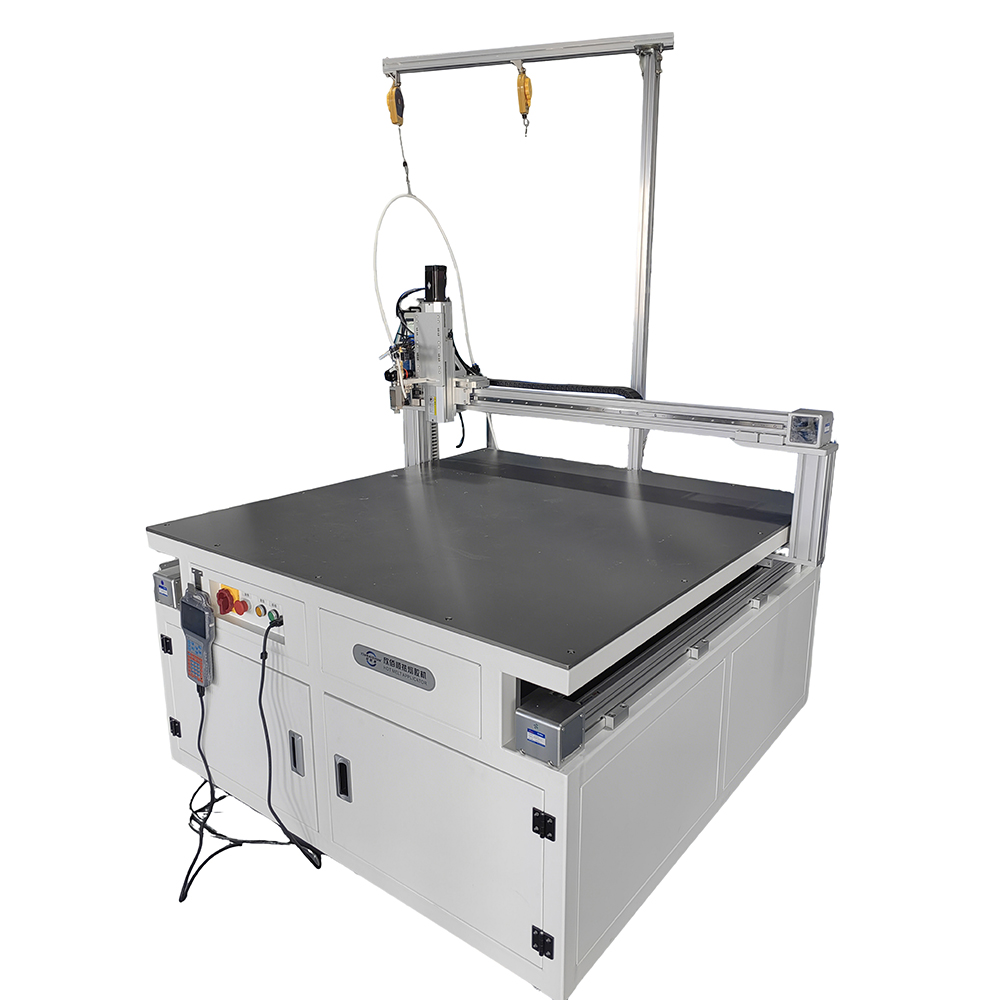
An automated XYZ Axis Glue Machine completely replaces operator guesswork. It uses programmable, 3D spatial interpolation to lay down exact fluid volumes automatically. You will discover exactly how this equipment establishes a highly reliable baseline for production scaling. We will explore structural drive systems, advanced vision upgrades, and practical steps you can take to ensure long-term quality assurance across your manufacturing floor.
Precision Hardware: True 3D movement backed by servo motors and ball screws can achieve repeat positioning accuracy down to ±0.01mm.
Waste Reduction: Automated dynamic mixing and anti-drip mechanisms eliminate material curing waste and rework caused by stringing.
Scalability: Standard XYZ setups can be upgraded with machine vision and multi-axis configurations to handle complex, high-mix production lines.
Vendor Evaluation: Partnering with a reliable XYZ axis glue machine manufacturer requires assessing their software ecosystem, hardware rigidity, and integration support.
Understanding automated dispensing requires examining its core spatial mechanics. A Cartesian coordinate system establishes the physical framework for the equipment. It utilizes three orthogonal axes: X (left and right), Y (forward and backward), and Z (up and down). This configuration allows continuous path dispensing across three dimensions. You can program the system to execute straight lines, perfect circles, sweeping arcs, and complex 3D contours. The controller coordinates all three axes simultaneously. This ensures the dispensing nozzle maintains a constant speed and distance from the substrate.
Motion control heavily dictates final application quality. Basic desktop dispensers often use simple stepper motors. Steppers operate on an open-loop system. They send power pulses to move the motor but do not verify the final position. This works for lightweight tasks. However, it risks skipped steps when manipulating heavy valves or viscous fluids. Industrial production demands higher reliability. Upgraded models contrast these basic steppers by utilizing industrial-grade servo motors paired with ball screw drivetrains. Servo systems operate in a closed loop. They use internal encoders to constantly read and correct their position. This configuration supports heavy-duty, continuous operation without step loss.
You cannot achieve micro-level precision on a weak foundation. Chassis design plays a massive role in dampening vibration. Fabricated sheet metal frames often flex under rapid movement. Conversely, an aluminum die-cast chassis offers superior rigidity. This structural integrity proves essential during high-speed directional changes. Advanced robots can reach travel speeds up to 800mm/s. A rigid frame absorbs the kinetic shock generated when the dispensing head abruptly stops or turns. It maintains micro-level accuracy and prevents the nozzle from shuddering, which would otherwise ruin a delicate glue bead.
Manual fluid application consistently fails at scale due to fluid dynamics and human error. Upgrading to an automated platform directly addresses these persistent failures through controlled mechanical interventions.
Eliminating Stringing and Tailing: High-viscosity materials like silicone often stretch into thin threads when you pull the needle away. This stringing contaminates sensitive PCB components. Automated valves feature programmable vacuum pull-back. This creates moment resorption at the nozzle. It actively sucks the fluid back inside the valve the instant the cycle finishes. It prevents silicone or epoxy from dripping entirely.
Managing Two-Part (AB) Adhesives: Manual operators hate mixing two-part epoxies. It introduces air bubbles and variable mixing ratios. Automated systems solve this by utilizing onboard dynamic mixing valves. They pull material from pressurized, sealed AB buckets. This completely replaces manual degassing. Keeping these vacuum seals intact provides a massive operational benefit. It prevents ambient moisture from interacting with polyurethane hardeners, halting unwanted crystallization.
Consistent Volumetric Control: Manual syringe pressure varies based on operator fatigue. Automated software manages timed quantitative filling instead. The system calculates exact fluid pressure and valve opening duration. It ensures an identical fluid volume hits the target per cycle. It completely eliminates the subjective variables of human operation.
A modern XYZ Axis Glue Machine adapts easily to diverse industry requirements. Its programmable nature allows operators to switch techniques without changing out massive hardware components. This morphological flexibility defines its value on the factory floor.
You can execute drastically different patterns based on the programmed path. The machine can dispense discrete micro-dots down to 0.1mm diameters for SMD component bonding. A quick program change allows it to lay down continuous beads for sealing enclosures. You can also configure it for surface potting to encapsulate sensitive electronics or perform stitching patterns for structural reinforcements. The software controls the transition between these modes seamlessly.
The telecommunications and automotive sectors rely heavily on Form-in-Place gaskets. Dispensing direct-to-part EMI shielding or structural gaskets delivers exceptional ROI. Traditionally, manufacturers bought pre-cut rubber filters or gaskets. Workers manually applied them using adhesives. Automation bypasses the need for pre-cut, post-processed filters entirely. The dispensing nozzle simply traces the enclosure perimeter. It deposits a precise bead of conductive silicone that cures in place. This cuts inventory costs and accelerates production.
You must acknowledge material compatibility to achieve perfect results. Standard valves easily handle basic epoxies and polyurethanes. However, applying high-viscosity thermal pastes or abrasive silver pastes presents unique challenges. Transparent guidance dictates that extreme viscosity fluctuations require hardware adjustments. Cold factory environments make silicone stiff and hard to push. You might still require heated valves to thin the material. Similarly, you may need real-time pressure compensation systems to adjust pneumatic force as the syringe empties. Recognizing these flow dynamics prevents unnecessary machine downtime.
Basic automation solves many problems, but it has natural boundaries. You must assess advanced upgrades when your production environment introduces complex variables.
A standard 3-axis system relies on "blind" automation. It moves exactly to the coordinates you programmed. It assumes the underlying part sits perfectly in its fixture. This implementation risk becomes obvious quickly. Basic XYZ robots struggle heavily against high product-mix lines. They also fail when handling parts with poor dimensional tolerances. If a plastic housing shrinks slightly during molding, the blind robot will dispense glue into thin air.
You solve blind dispensing by giving the robot eyes. Machine vision systems utilize "Eye-to-Hand" camera calibration. The camera mounts above the workspace, taking a high-resolution snapshot of the entire tray. Advanced algorithms extract exact coordinate data from this image. They locate fiducial markers on the parts. The software then dynamically self-corrects the dispensing paths before the needle even moves.
This achieves extraction errors below 0.02mm. It easily compensates for misaligned trays or rotated parts. Furthermore, you see massive efficiency gains up to 30%. The vision algorithms optimize toolpaths, calculating the shortest route between points, which drastically reduces wasted travel time.
Three axes cover most flat or lightly contoured surfaces. However, complex geometries demand axis expansion. Adding a rotational (R-axis) or tilt capability becomes mandatory for 3D topologies. You will need these extra axes for dispensing on vertical interior walls or applying glue underneath an overhanging ledge. A 5-axis setup allows the nozzle to approach the substrate from any angle, safely navigating complex product topologies without collision.
Configuration | Ideal Application Profile | Key Hardware Upgrades | Primary Limitation |
|---|---|---|---|
Standard 3-Axis | Flat PCB potting, rigid tray batches, identical parts. | Servo motors, precision ball screws. | Blind to part misalignments. |
Vision-Guided (AOI) | High product-mix lines, parts with poor tolerances. | Overhead camera, visual alignment software. | Restricted to top-down planar dispensing. |
4th/5th Axis System | Deep internal cavities, side-wall dispensing, 3D contours. | Rotational joints, tilt mechanisms. | Requires advanced programming skills. |
Selecting the right hardware is only half the battle. You must partner with a vendor capable of supporting your specific production goals. Choosing a credible XYZ Axis Glue Machine manufacturer requires strict evaluation across several technical dimensions.
Never purchase fluid automation equipment based purely on a specification sheet. Fluid dynamics behave unpredictably. A credible manufacturer should offer extensive sample testing before purchase. You must ship your specific adhesives and parts to their facility. This proof of concept validates fluid behavior, ensures correct curing times, and confirms achievable cycle speeds. If the vendor cannot prove success on your actual parts, look elsewhere.
Evaluate the software interface carefully. An overly complex system paralyzes a production floor. Assess whether the manufacturer provides intuitive teach pendants. These handheld devices allow floor operators to program rapid changeovers using simple graphic interfaces. If the system strictly relies on complex G-code programming, it dramatically increases your operator training requirements. You want software that balances deep customization with daily usability.
Determine exactly what the vendor supplies. Do they provide a complete ecosystem? Turnkey integration means they supply the valves, the vision systems, the feed conveyors, and the UV curing ovens all communicating together. Conversely, some vendors just sell the bare motion platform. Standalone purchases force your internal engineering team to act as the systems integrator. This delays deployment and creates accountability gaps if the valve fails to talk to the robot.
Look closely at practical implementation realities. You must assess actual setup time for high-mix/low-volume lines. If your factory runs fifty different product variations daily, you need fast mechanical changeovers. Frequent reprogramming and nozzle swapping might offset the very automation gains you sought to achieve. Ensure the manufacturer offers quick-release valve mounts and easy recipe-recall software functions to minimize line downtime.
Moving to an XYZ automated dispensing system represents a strategic shift for your factory. You successfully transition away from variable labor constraints toward fixed, predictable process control. By controlling the spatial movement and fluid volume mathematically, you instantly eliminate stringing, uneven beads, and wasted rework.
We recommend starting with a simple, single-sided dispensing application. This allows you to validate process reliability before you scale up to multi-axis, vision-guided workcells. Do not guess on compatibility. Reach out to your equipment partner and request a material-specific capability audit today. Testing your exact adhesive against their hardware is the safest way to guarantee operational success.
A: The minimum dot size depends heavily on needle gauge, fluid viscosity, and the specific valve type. Pneumatic time-pressure valves generally achieve 0.5mm dots. However, advanced setups utilizing piezoelectric jetting valves shooting low-viscosity materials can successfully reach micro-dot diameters down to 0.1mm.
A: Yes, if your part positioning varies slightly in the tray, or if you require active quality inspection for bead width. No, if you run high-volume, identical parts secured rigidly in precision-machined fixtures. Vision is an upgrade for managing tolerance variations.
A: The distinction lies primarily in output volume, footprint, and precision. XYZ dispensing machines handle micro-applications, tracing complex paths with tiny fluid amounts. Potting machines handle bulk void-filling. They dispense massive volumes of two-part resins quickly to entirely encapsulate large electronic housings.