Views: 0 Author: Site Editor Publish Time: 2026-07-31 Origin: Site
End-of-line packaging bottlenecks frequently erode manufacturing profit margins. Operations managers must re-evaluate legacy carton sealing methods to maintain throughput. Balancing the demand for higher line speeds and superior package security against equipment maintenance realities dictates your packaging strategy. Moving from manual or semi-automated tape dispensers to an automated hot melt glue applicator requires a rigorous analysis of production volume and specific substrate bonding requirements. Packaging lines need reliable, fast, and secure sealing solutions. Tape sealing often struggles to keep up with high-speed conveyors. Hot melt adhesive systems offer a robust alternative. We will examine how these two methods compare across throughput, seal integrity, and operational scalability to help you optimize your end-of-line packaging process.
Cost Dynamics: While tape sealing offers lower initial equipment costs, hot melt adhesives typically reduce ongoing consumable expenses by up to 75% for high-volume operations.
Throughput Scalability: Automated hot melt systems cure in seconds, supporting significantly higher cartons-per-minute (CPM) rates compared to mechanical tape application, which can take more than double the time to seal and compress.
Seal Integrity: Hot melt provides a permanent, tamper-evident destructive bond, whereas tape is susceptible to environmental degradation, dust interference, and undetected pilferage.
Weight & Substrate Considerations: Tape is highly viable for standard, medium-weight cartons in low-volume runs, but heavy-duty, high-stress, or recycled structural packaging requires the mechanical bonding strength of synthetic resins.
Implementation Reality: Transitioning to hot melt requires upfront investment in equipment, operator safety training, and scheduled preventative maintenance to manage adhesive charring and nozzle clogs.
Choosing the right sealing method dictates the efficiency of your entire packaging line. Operations must define the required cartons-per-minute. You must evaluate how sealing speed impacts upstream production lines. Slow sealing creates bottlenecks that halt manufacturing. When a case sealer jams or runs out of tape, the entire conveyor system backs up. This forces upstream operators to pause filling operations. You need a sealing method that matches or exceeds your filler speeds.
Carton weight and load stress play a massive role in this decision. Categorize packaging needs by weight. Light, medium-weight, or heavy-duty structural cartons require different approaches. This determines the necessary shear and tensile strength of the seal. Heavy loads demand aggressive bonding. If you ship dense products like canned goods or metal hardware, the outward pressure on the carton flaps is immense. A weak seal will fail during palletization or transit.
Substrate and environmental factors cannot be ignored. Assess corrugated board types, including recycled content and coatings. Storage conditions like extreme temperatures, high humidity, and dust-heavy environments affect bond failure rates. You must also evaluate the necessity for tamper-evident packaging in industries like pharmaceuticals, electronics, food and beverage, or high-value consumer goods. Recycled boards have shorter fibers. These shorter fibers break away easily when using standard pressure-sensitive tape. You need an adhesive that penetrates deep into the board structure.
Consider the physical footprint of the sealing equipment on your factory floor. Space is often at a premium. Tape sealers require physical space for the tape heads and the compression rollers. Adhesive systems require space for the melting unit and the heated hoses. You must map out your end-of-line layout to ensure operators have safe access for maintenance and material replenishment.
Operator ergonomics also factor into the success criteria. Manual taping requires repetitive wrist and shoulder movements. This leads to fatigue and potential strain injuries over a long shift. Automated systems remove this physical burden. Operators transition from manual laborers to machine supervisors. They monitor adhesive levels and system diagnostics instead of physically applying tape to hundreds of boxes per hour.
Tape sealing presents a low barrier to entry. It features low initial equipment costs and minimal operator training. Deployment is easy using manual hand dispensers or semi-automatic case tapers. This makes tape popular for low-volume or highly variable packaging runs. You can set up a manual taping station in minutes. Operators require almost no technical training to use a hand dispenser. For small batch runs or custom orders, tape provides immediate utility.
However, consumable costs accumulate rapidly. You must analyze the hidden costs of tape. Frequent roll changeovers cause downtime. Material waste and price volatility in plastic, paper, and acrylic adhesive markets add up. Tape also suffers from structural vulnerabilities. Dust, moisture, and recycled corrugated fibers compromise tape adhesion. This leads to pop-opens and structural failures during transit. When a tape roll runs out, the machine stops. An operator must physically remove the empty core, thread a new roll through the tension rollers, and restart the machine. This process takes several minutes.
Throughput ceilings are a major limitation. Tape heads have mechanical limits. The compounding downtime associated with manual roll replacement in automated case sealers dramatically slows cycle times. This contrasts sharply with continuous adhesive feeding systems. If your line runs at fifty cartons per minute, a tape roll might only last twenty minutes. That means three line stoppages per hour just for material replenishment. This severely limits your maximum daily output.
Tape application also requires physical pressure. The carton must pass through compression rollers to activate the pressure-sensitive adhesive. If the carton is under-filled, the top flaps will cave in under the rollers. This results in a weak seal and a damaged carton. You must ensure your cartons are perfectly sized and filled to the brim to achieve a reliable tape seal. This adds complexity to your packaging design and filling processes.
Environmental degradation is another significant issue with tape. Acrylic and hot melt tapes behave differently in extreme temperatures. If you ship products in uninsulated trailers during the summer, the adhesive on the tape can soften and release. In freezing conditions, the adhesive can become brittle and crack. You must select specific, often more expensive, tape formulations to combat these environmental challenges.
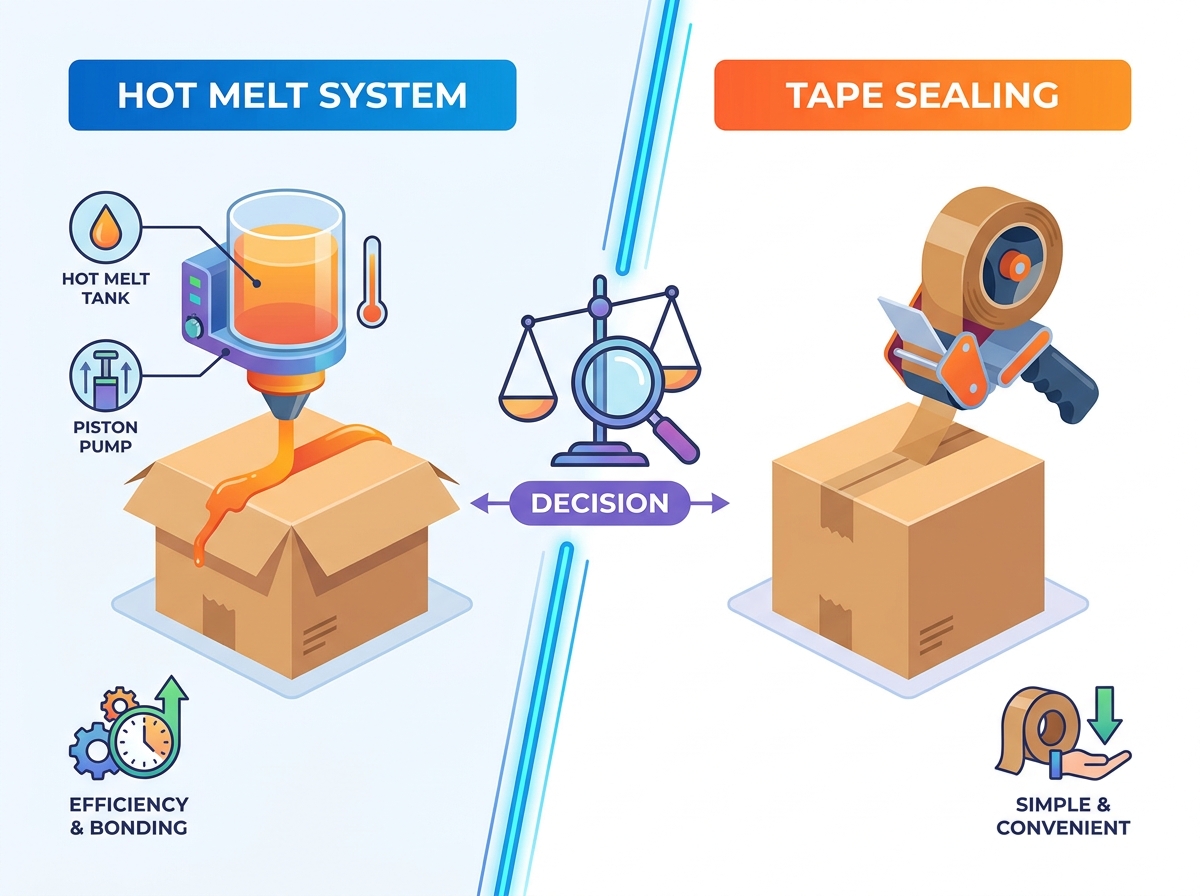
An industrial adhesive setup relies on precise system architecture. The core components include the hot melt tank, heated hoses, dispensing heads, and the integrated control interface. These parts work together to melt, transport, and apply adhesive accurately. The tank melts the solid adhesive pellets or chubs into a liquid state. The heated hoses maintain the adhesive at the exact application temperature as it travels to the dispensing heads. The dispensing heads use pneumatic or electric valves to fire precise patterns of adhesive onto the carton flaps.
Delivery mechanisms vary based on application needs. A piston pump hot melt glue machine offers excellent reliability for standard packaging. Gear pumps are better suited for high-precision, continuous flow. Pump choice impacts maintenance schedules and application consistency. Piston pumps use a reciprocating action to push the adhesive. They are robust and handle a wide range of adhesive viscosities. Gear pumps use rotating gears to meter the adhesive. They provide a smooth, continuous flow, which is critical for high-speed lines requiring exact adhesive volumes.
Adhesive chemistry dictates performance. Synthetic resins, specifically EVA and metallocene adhesives, feature specific polymer structures. These structures dictate melt rates, open times, and set times. Furthermore, a modern hot melt glue machine for bonding interfaces easily with programmable logic controllers. This ensures seamless end-of-line automation with existing conveyor systems. EVA adhesives are the industry standard for general packaging. They offer good adhesion to standard corrugated boards. Metallocene adhesives are more advanced. They burn cleaner in the tank, reducing char and maintenance. They also offer better adhesion to difficult substrates and perform well in extreme temperatures.
The control interface is the brain of the system. Modern applicators feature touchscreen interfaces that allow operators to set precise temperatures for the tank, hoses, and heads independently. They also control the firing timing and pattern of the adhesive. You can program the system to apply a continuous bead, a stitched bead, or individual dots. This flexibility allows you to optimize adhesive usage based on the specific carton size and weight.
Filtration is a critical component of the mechanics. Contaminants in the adhesive can clog the fine nozzles in the dispensing heads. Applicator systems use multiple stages of filtration. There is typically a coarse filter in the tank and finer filters in the hoses or heads. Regular filter changes are mandatory to maintain consistent adhesive flow and prevent line stoppages.
Hot melt offers a rapid set time, often under three seconds. This eliminates the need for extended compression zones. Tape application requires mechanical wiping and physical pressure. This takes more than double the processing time. Bulk feeding systems allow for continuous operation without stopping the line. Tape requires frequent downtime for roll changeovers. You can install an auto-feeder on a hot melt system. This device automatically pulls solid adhesive pellets from a bulk bin into the melting tank as needed. The operator never has to stop the line to add adhesive.
Scalability is a major advantage of adhesive systems. If you need to increase your line speed, you can simply adjust the pump pressure and the firing timing on the applicator. The system will apply the adhesive faster to match the conveyor speed. With tape, you are limited by the mechanical speed of the tape head. If you run the carton through the tape head too fast, the tape will snap or apply unevenly. You eventually hit a hard ceiling on throughput with tape sealing.
Hot melt penetrates corrugated fibers deeply. It creates a fiber-tearing, permanent bond upon opening. This provides inherent, visual tamper evidence that pressure-sensitive tape cannot replicate. Hot melt also boasts superior resistance to shifting pallet loads. It withstands extreme temperature fluctuations from freezers to shipping containers much better than tape. If a thief tries to open a glued carton, they must physically tear the cardboard. This leaves obvious damage. A thief can often peel tape back with a heat gun and replace it without leaving a trace.
The structural integrity provided by adhesive is unmatched. When you glue the flaps of a carton together, you create a rigid, unified structure. The glued flaps act as a structural beam across the top and bottom of the box. This significantly increases the compression strength of the carton. You can stack glued cartons higher on a pallet without the bottom boxes crushing. Tape simply holds the flaps closed; it does not add structural rigidity to the carton.
Hot melt ensures clean packaging design. It eliminates obscuring tape lines. Logos, barcodes, and custom-printed branding on carton flaps remain fully visible and professional. Adhesive applied directly to carton flaps also contributes to overall structural rigidity. It improves the squariness and stacking strength of the palletized carton. If you spend money on high-quality graphics for your packaging, you do not want to cover them up with clear or brown tape. Adhesive sealing keeps the exterior of the box completely clean.
A clean box exterior also improves barcode readability. Automated sorting facilities rely on scanners to read barcodes on the cartons. If tape covers a barcode, the scanner might fail to read it. This causes the carton to be rejected or misrouted. Adhesive sealing ensures that all printed information on the carton remains unobstructed and easily scannable.
Performance Metric | Tape Sealing | |
|---|---|---|
Set Time | 1 to 3 seconds | Requires mechanical wiping and compression |
Tamper Evidence | High (Fiber-tearing destructive bond) | Low (Can be peeled and replaced with heat) |
Continuous Operation | Yes (Via automated bulk pellet feeding) | No (Requires line stops for roll changeovers) |
Aesthetics | Clean, hidden seal preserves branding | Visible tape lines obscure graphics |
Structural Rigidity | Adds compression strength to the carton | Provides no additional structural support |
Working with molten adhesive presents thermal hazards. Temperatures can reach 350 degrees Fahrenheit. Facilities must implement proper personal protective equipment and safety protocols. Operator training is non-negotiable. Operators must wear heat-resistant gloves and safety glasses when performing maintenance or manually filling the tank. You must establish clear lockout/tagout procedures for the equipment to prevent accidental burns during servicing.
Maintaining the equipment requires diligence. Prevent adhesive charring, nozzle clogging, and pump degradation through regular system flushes. Use proper filtration. Mitigate downtime risks from system heat-up times by using programmable weekly timers and standby modes. Charring occurs when adhesive sits in the tank at high temperatures for extended periods. The adhesive degrades and turns into hard, black flakes. These flakes travel through the hoses and clog the nozzles. You must implement a strict maintenance schedule to clean the tank and replace filters.
Identify highly coated or waxed boards early. These may require specialized synthetic resin formulations to ensure deep fiber penetration. Standard EVA adhesives will not bond to heavily waxed cartons. The wax prevents the adhesive from reaching the paper fibers. You must work with your adhesive supplier to select a formulation specifically designed for coated substrates. Always perform bond tests on your actual production cartons before finalizing your adhesive selection.
System heat-up time is a logistical challenge. A large melting tank can take up to an hour to reach operating temperature from a cold start. If operators wait until the start of their shift to turn on the machine, you lose an hour of production time. Utilize the programmable timers built into the control interface. Set the machine to turn on automatically an hour before the shift begins. Use the standby mode during breaks to lower the temperature slightly, reducing charring while allowing for a rapid return to operating temperature.
Air supply quality affects system reliability. Applicator heads rely on compressed air to open and close the dispensing valves rapidly. If your factory air supply contains moisture or oil, it will damage the pneumatic components in the heads. You must install dedicated air dryers and filters on the air lines feeding the adhesive system. Clean, dry air ensures consistent valve operation and prevents premature component failure.
Verify the electrical requirements for the melting unit and heated hoses before installation.
Install dedicated air filtration to protect the pneumatic dispensing valves from moisture.
Establish a daily checklist for operators to inspect nozzle alignment and filter status.
Stock spare nozzles, filters, and hose components to minimize downtime during component failure.
Conduct a packaging line audit to calculate current per-carton sealing times and material waste.
Request sample substrate testing from adhesive manufacturers to verify bond strength on your specific corrugated boxes.
Evaluate specific applicator configurations, comparing single versus multi-hose setups based on your line layout.
Schedule a safety and maintenance training session for operators before installing new adhesive equipment.
A: Yes. Highly recycled corrugated boxes have shorter fibers, which can make tape adhesion difficult. Hot melt adhesives penetrate these shorter fibers effectively, creating a strong, destructive bond that secures the carton.
A: Hot melt is significantly better for heavy-duty loads. The adhesive provides superior shear and tensile strength, preventing flaps from popping open under high stress or heavy pallet stacking.
A: Basic preventative maintenance, like wiping nozzles and checking filters, should be done daily or weekly. A full system flush to remove charring is typically recommended every three to six months, depending on usage and adhesive type.
A: A piston pump uses a reciprocating mechanism, making it durable and ideal for standard, intermittent packaging applications. A gear pump provides a continuous, highly precise flow of adhesive, which is better for continuous high-speed lines.
A: Hot melt seals are highly resilient to temperature extremes once cured. Tape often flags, peels, or dries out in extreme heat or freezing conditions, whereas specific hot melt formulations are designed to withstand these environments.