Views: 0 Author: Site Editor Publish Time: 2026-08-07 Origin: Site
In industrial assembly and packaging, the precision of adhesive application directly dictates structural integrity, aesthetic finish, and material cost efficiency. Selecting an incompatible nozzle geometry leads to adhesive stringing, premature curing, frequent clogging, and excessive adhesive consumption. A misalignment between the nozzle and the applicator system creates bottlenecks that compromise entire production lines. Plant managers and maintenance engineers often trace recurring line stoppages back to a single, overlooked component at the end of the extrusion path. This guide breaks down the technical specifications, performance trade-offs, and system compatibility requirements for evaluating and selecting the optimal nozzle for commercial and industrial adhesive applications. We will examine how fluid dynamics, thermal retention, and orifice geometry interact to determine bond quality, providing a framework to eliminate application errors and reduce material waste across high-volume manufacturing environments.
Application Dictates Geometry: Bead, spray, and spreader nozzles serve distinct functions; selecting the right profile balances coverage area with adhesive open time.
Orifice Size Trade-offs: Smaller orifices provide high precision for dot applications but exponentially increase clogging risks. Conversely, larger orifices reduce downtime but escalate adhesive waste and material costs.
System Integration is Critical: A nozzle must be evaluated not in isolation, but as the terminal component of a complete system, matching the pressure output of the hot melt tank and pumping mechanism.
Material and Maintenance: Built-in check valves and wear-resistant materials (like stainless steel over brass) are non-negotiable for high-volume, automated production environments.
Modular Versatility: Utilizing unified nozzle kits offers manufacturers the adaptability to switch between production runs without investing in entirely new applicator systems.
The primary function of a nozzle is to control the flow rate, pattern, and thermal stability of the adhesive at the exact point of application. A well-specified nozzle ensures that the adhesive is deposited exactly where needed, in the correct volume, without excess stringing or dripping. It acts as the final control valve in your dispensing process. If the nozzle fails to regulate flow accurately, the entire assembly process suffers from poor bond strength or messy aesthetics. In field operations, a nozzle that cannot maintain a sharp cutoff will drag adhesive across the substrate, ruining the product finish and fouling downstream conveyor belts.
A nozzle does not operate independently. It relies heavily on upstream components to function correctly. The journey begins at the melting unit, where solid adhesive is converted to a liquid state. From there, the liquid adhesive travels through heated hoses, maintaining a specific temperature profile, until it reaches the applicator head. The hot melt glue applicator must deliver the adhesive to the nozzle at a consistent pressure and temperature. Any fluctuation in this delivery chain directly impacts the extrusion pattern at the nozzle tip. Operators must view the entire setup as a single thermal and hydraulic circuit.
Maintaining consistent thermal dynamics at the nozzle tip is mandatory. If the nozzle temperature drops, the adhesive can prematurely cool, leading to increased viscosity, poor substrate penetration, and ultimately, cold joints. Conversely, if the nozzle is too hot, the adhesive may char, causing blockages and degrading the bond quality. Proper thermal management ensures the adhesive remains at its optimal application temperature right up to the moment it contacts the substrate. Many modern systems utilize independent heating zones at the nozzle block to fine-tune this final temperature stage, compensating for ambient air cooling on fast-moving production lines.
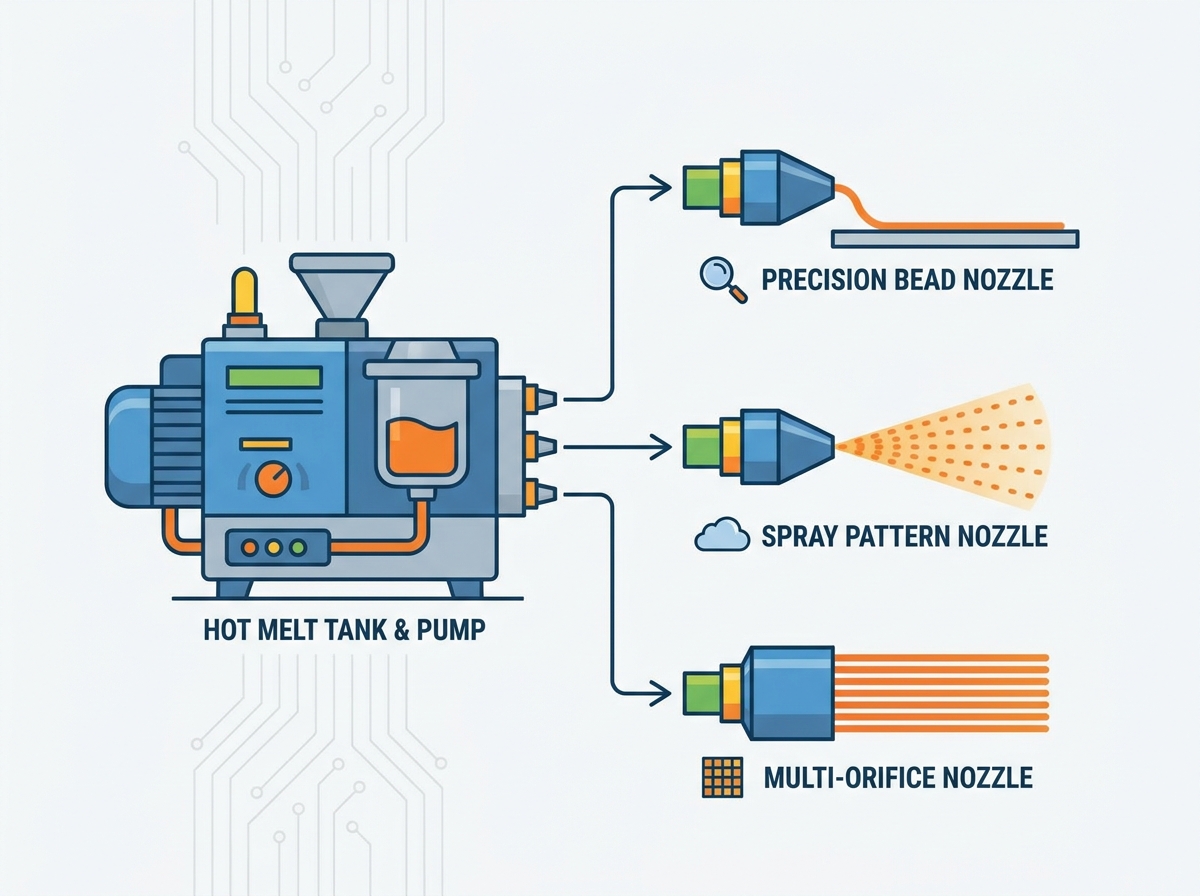
Bead and dot nozzles are engineered to extrude single continuous lines or intermittent dots of adhesive. They are the standard choice for applications requiring high precision and targeted adhesive placement. These nozzles restrict the flow to a narrow stream, allowing for exact positioning on the substrate. The internal geometry usually features a steep taper leading to the orifice, which accelerates the fluid and ensures a clean break when the valve closes.
Common use cases include carton sealing, profile wrapping, and precise component assembly. In carton sealing, a quick dot or short bead provides a strong, fast-setting bond. For profile wrapping, a continuous bead ensures consistent adhesion along the entire length of the material. When evaluating these nozzles, standard orifice diameters typically range from 0.012 to 0.040 inches. The chosen diameter must align with the adhesive viscosity and the production line speed. Thicker adhesives or faster line speeds generally require larger orifices to prevent flow restriction and ensure adequate volume delivery. Using a 0.012-inch orifice with a high-viscosity packaging glue will immediately cause pump cavitation and inconsistent bead widths.
Spray and swirl nozzles utilize compressed air to atomize the adhesive, creating a swirl or random fiber pattern. This method distributes a thin layer of adhesive over a large surface area without applying excessive heat or material weight to the substrate. The applicator head introduces heated air just as the adhesive exits the fluid nozzle, catching the glue stream and spinning it into a controlled web.
These nozzles are ideal for foam bonding, upholstery, and temperature-sensitive substrates. By spreading the adhesive thinly, the heat dissipates rapidly, preventing damage to delicate materials like thin plastics or foams. However, this rapid cooling presents a trade-off. While you achieve wider surface coverage, the adhesive experiences faster cooling rates, resulting in significantly shorter open times. Operators must join the substrates quickly before the adhesive sets. Air pressure regulation is highly sensitive here; too much air pressure will blow the adhesive past the target area, while too little will result in heavy, uneven globs rather than a fine web.
Spreader nozzles are designed for high-volume surface bonding, extruding a wide, flat film of adhesive or multiple parallel beads simultaneously. Flat spreaders create a continuous thin film across a specific width, while multi-hole spreaders feature specialized configurations, such as 2-hole or 3-hole designs, to lay down parallel bead lines. The internal manifold of a slot nozzle must be perfectly machined to distribute fluid pressure evenly across the entire width of the slot.
These nozzles excel in edge banding, laminating, labeling, and large-format packaging. For example, applying parallel bead lines on wide carton flaps provides excellent structural integrity while using less adhesive than a solid film. When evaluating spreader nozzles, it is vital to assess the requirement for uniform pressure distribution across the slot or multi-hole width. Uneven pressure can lead to inconsistent adhesive thickness or bypass starvation, where some areas receive too much adhesive while others receive none. Shimming the slot gap is a common field adjustment to dial in the exact coat weight required for lamination processes.
Nozzle Category | Primary Function | Typical Orifice/Width | Best Use Cases | Key Operational Challenge |
|---|---|---|---|---|
Bead and Dot | Targeted, high-pressure extrusion | 0.012" - 0.040" | Carton sealing, assembly | Clogging in micro-orifices |
Spray and Swirl | Air-atomized wide coverage | Variable (Air assisted) | Foam, upholstery, thin films | Managing rapid cooling/short open times |
Flat Slot Spreader | Continuous wide film | 1" to 24"+ widths | Laminating, edge banding | Maintaining even pressure across the slot |
Multi-Hole Spreader | Parallel bead lines | Custom hole spacing | Large format packaging | Preventing starvation at outer holes |
Adhesive viscosity plays a major role in nozzle selection. High-viscosity adhesives resist flow and require larger orifices or higher system pressure to extrude properly. Forcing a thick adhesive through a micro-orifice will cause severe flow restriction, leading to inconsistent application and potential equipment strain. Conversely, low-viscosity adhesives flow easily and require smaller orifices to prevent dripping and over-application. You must match the centipoise (cps) rating of the adhesive at operating temperature to the nozzle's flow capacity.
Different adhesive formulations also dictate nozzle choice. EVA (Ethylene Vinyl Acetate) adhesives are versatile and work well with standard bead nozzles. Metallocene adhesives, known for their clean running properties and thermal stability, often allow for smaller orifice sizes without clogging. PUR (Polyurethane) adhesives cure via moisture in the air, requiring specialized, moisture-sealed nozzles to prevent the adhesive from curing inside the applicator during downtime. If a standard brass nozzle is used with PUR, the adhesive will cross-link at the tip overnight, requiring a complete teardown and rebuild of the applicator head the next morning.
Selecting the orifice size involves a constant balancing act. Micro-orifices provide exceptional precision for detailed dot applications, ensuring clean, tight bonds. However, this precision comes with an increased susceptibility to clogging. Even microscopic impurities or slight adhesive charring can block a micro-orifice, necessitating strict inline filtration and rigorous maintenance protocols. A 100-mesh filter is typically required upstream when running orifices smaller than 0.016 inches.
On the other hand, macro-orifices significantly reduce downtime and clogging risks. They allow impurities to pass through without interrupting flow. Yet, larger orifices automatically deposit more adhesive. This leads to over-application, slower set times due to the increased thermal mass, and inflated material consumption costs. Choosing the right size requires analyzing the specific needs of the application against acceptable maintenance and material costs. Upsizing a nozzle by just a few thousandths of an inch can increase annual adhesive consumption by thousands of pounds on a high-speed line.
A high-quality glue gun nozzle often incorporates built-in check valves to control adhesive flow precisely. These mechanisms, typically needle-and-seat or ball-check valves, are integrated directly into the precision tip. They open under pressure to allow extrusion and snap shut instantly when pressure drops. The spring tension inside the check valve must be calibrated to the specific operating pressure of the system.
These anti-drool features are critical for maintaining a clean production environment. They prevent stringing and dripping between applications, which reduces cleanup downtime and eliminates adhesive waste on automated lines. In high-speed packaging, even a small drop of misplaced adhesive can jam machinery, foul optical sensors, or ruin the appearance of the final product, making check valves an essential feature for reliable operation. Without a positive shut-off at the tip, residual pressure in the manifold will cause the nozzle to weep adhesive long after the solenoid has closed.
The nozzle must be compatible with the upstream delivery system. The melt rate and pressure capacity of the hot melt tank dictate the maximum viable orifice size and the number of active nozzles a system can support. If a tank cannot melt adhesive fast enough to supply a large spreader nozzle, the system will experience starvation, resulting in incomplete bonds. You cannot put a high-flow slot nozzle on a tank designed for low-volume bead extrusion.
Furthermore, operators must account for pressure drops across the system. As adhesive travels through heated hoses and manifolds, friction causes a loss in pressure. Calculating this pressure drop ensures that the applicator head receives enough force to extrude the adhesive consistently at the nozzle tip, maintaining the desired pattern and volume. Long hose runs or restrictive fittings will severely reduce the pressure available at the nozzle, requiring either a larger orifice or a higher pump pressure setting to compensate.
The type of pump driving the adhesive significantly impacts nozzle performance. A piston pump hot melt glue machine operates with a pulsating action, creating slight variations in flow pressure during the pump stroke. This pulsation can cause uneven bead widths or intermittent spraying if not properly managed. The "wink" in the pressure line occurs exactly when the piston changes direction.
To mitigate these flow inconsistencies, systems often utilize pressure regulators and specific nozzle designs engineered to smooth out the extrusion. While continuous gear pumps provide a steadier flow, piston pumps remain highly effective for many applications when paired with the correct regulatory components and nozzle geometries to absorb the pressure spikes. Adding a fluid pressure regulator just before the applicator head can dampen the piston stroke effect, allowing for highly accurate bead placement even with a pulsating pump source.
For manual operations, the applicator's wattage determines its thermal output capacity. High-wattage manual applicators, such as 400W heavy-duty industrial systems, can support larger or multi-hole nozzles without experiencing temperature drop-offs during continuous use. Low-wattage systems struggle to maintain heat when extruding large volumes, risking cold joints and poor adhesion. If the operator pulls the trigger and the adhesive comes out thick and stringy, the heater block cannot keep up with the flow rate.
Additionally, the size of the manual glue stick (e.g., 1/2-inch, 5/8-inch, or Q-size) limits the overall output capacity. A smaller glue stick simply cannot feed enough material to sustain a wide flat spreader nozzle effectively. Matching the applicator's feed-stock configuration to the nozzle's volume requirements is necessary for consistent manual application. Trying to push a high volume of adhesive through a small manual gun will only result in operator fatigue and inconsistent bond lines.
In high-mix production environments where application requirements change frequently, purchasing specialized nozzle kits offers significant operational flexibility. These kits typically contain various configurations, including extension nozzles for hard-to-reach areas, spreader tips for wide coverage, and micro-precision orifices for detailed work. Having the right geometry on hand prevents operators from trying to "make do" with the wrong nozzle, which always leads to quality defects.
Modular kits allow operators to perform quick changeovers on the production floor. Instead of investing in dedicated individual applicators for every specific product line, a single applicator can be adapted rapidly by swapping the nozzle. This approach maximizes equipment utilization and reduces overall capital expenditure while maintaining high production agility. A standard changeover should take less than five minutes if the correct tools and replacement nozzles are staged at the workstation.
One of the most common implementation risks is adhesive charring. When adhesive remains stagnant in the heated nozzle tip for extended periods, it undergoes thermal degradation. This degraded material hardens into char, which eventually breaks loose and blocks the orifice, halting production. Char acts like sand in the system, destroying pump seals and scoring the internal surfaces of the applicator valves.
Mitigating this risk requires strict operational procedures. Implementing proper purging protocols before shutting down the line clears residual adhesive. Utilizing temperature setback features lowers the heat during short pauses, preventing degradation. Establishing routine maintenance schedules to clean or replace nozzles proactively ensures consistent flow and prevents unexpected blockages during critical production runs.
Activate the temperature setback mode if the line stops for more than 15 minutes.
Purge the system with fresh adhesive at the start of every shift to clear any degraded material from the manifold.
Inspect the nozzle tip daily for carbon buildup and clean with a brass wire brush while hot.
Replace inline filters every 500 hours of operation to catch char before it reaches the nozzle orifice.
Soak clogged nozzles in an approved heated solvent bath; never use steel picks or drill bits to clear an orifice, as this will permanently alter the flow geometry.
The material composition of the nozzle determines its longevity and performance in demanding environments. Brass nozzles offer excellent thermal conductivity, ensuring even heat distribution, but they wear quickly under abrasive conditions. Aluminum provides a lightweight alternative but shares similar wear limitations. If a brass nozzle is dragged across corrugated cardboard continuously, the orifice will widen and deform within a matter of weeks.
For high-volume production or applications involving abrasive adhesives, hardened stainless steel nozzles are recommended. While steel has lower thermal conductivity than brass, its superior wear resistance withstands high-friction contact applications, such as continuous carton rubbing. Selecting the right material balances thermal performance with the required durability for the specific production environment. Some specialized nozzles feature carbide inserts at the tip for extreme wear resistance in the harshest packaging environments.
When replacing nozzles, operators face the choice between Original Equipment Manufacturer (OEM) parts and aftermarket alternatives. Aftermarket nozzles often present initial cost savings, which can be appealing for tight maintenance budgets. However, these savings must be weighed against potential risks regarding tolerance variations and material quality. A poorly machined aftermarket nozzle can leak at the threads or fail to seat properly against the valve module.
Sourcing directly from a reputable hot melt glue machine manufacturer ensures guaranteed tolerance and warranty compliance. OEM parts are engineered specifically for the applicator system, ensuring seamless integration and reliable performance. When evaluating a vendor, consider their custom engineering capabilities, compatibility testing services, and replacement part lead times to ensure continuous support for your production lines. A strong manufacturer will offer application testing in their lab to prove out a nozzle geometry before you install it on your factory floor.
Selecting the optimal nozzle requires matching the physical geometry of the tip to the fluid dynamics of the adhesive and the pressure capabilities of the pumping system. Ignoring any of these variables results in poor bond quality, excessive downtime, and wasted material. By standardizing your evaluation process around viscosity, thermal retention, and wear resistance, you can eliminate the guesswork from adhesive dispensing.
Audit your current adhesive consumption and identify lines where over-application is occurring due to oversized orifices.
Verify that your hot melt tank and pump can supply the required pressure and volume for any new spreader or multi-hole nozzles before installation.
Implement a strict daily maintenance protocol that includes hot-brushing nozzle tips and utilizing temperature setback features during line pauses.
Transition to hardened stainless steel nozzles on any application where the tip makes physical contact with abrasive substrates like corrugated cardboard.
A: A bead nozzle extrudes a continuous, solid line or intermittent dots of adhesive, ideal for precise, structural bonding like carton sealing. A spray nozzle uses compressed air to atomize the adhesive into a swirl pattern, providing wide surface coverage with minimal heat transfer, suitable for temperature-sensitive materials like foam.
A: Prevent clogging and stringing by using nozzles with built-in check valves that snap shut when pressure drops. Maintain precise temperature settings to avoid adhesive charring, and utilize inline filtration systems to catch impurities before they reach the micro-orifice.
A: No. PUR adhesives cure when exposed to ambient moisture and require specialized, moisture-sealed nozzles to prevent curing inside the applicator. EVA adhesives do not have this requirement and can run through standard open-air bead or slot nozzles.
A: The tank's melt rate and pump pressure determine if it can sustain the required flow volume. If the tank cannot melt adhesive fast enough to supply a large or multi-hole nozzle, the system will starve, resulting in inconsistent extrusion and weak bonds.
A: Upgrade to a piston pump system when transitioning from manual handheld guns to automated, high-volume production lines. Piston pumps provide the consistent pressure and continuous flow necessary to drive automated applicator heads and multi-nozzle setups efficiently.
A: Uneven application from a flat spreader nozzle is typically caused by uneven thermal distribution across the nozzle width, partial blockages within the slot, or insufficient system pressure failing to distribute the adhesive uniformly across the entire extrusion path.
A: Multi-hole nozzles apply targeted, parallel lines of adhesive. This configuration reduces total material volume and cost while maintaining wide bonding coverage and structural integrity, whereas a flat slot nozzle applies a continuous, heavier film of adhesive.